March 7th, 2008 — Books, Controversy, Medicine, Science
Wow: Can you believe anything anybody writes any more?
The New York Times is still reeling after their gut-felt rave over the book Love and Consequences, and loving profile of its author, Margaret B. Jones. Love and… is Jones’ memoir of her life as a scrappy, foster white girl, growing up wild with the Bloods in the streets of South Central LA.
Meanwhile, Consequences are what her behind, the Times, and he publisher, Riverhead/Penguin, are feeling right this instant.
We now know that “Margaret B. Jones” is actually—get this—Margaret Seltzer. (Wow…does it get any whiter?) Instead of being dragged through inummerable foster homes, Seltzer was raised by both parents in the well-heeled San Fernando Valley. As opposed to ducking in and out of violent, drug-infested Compton alleyways, she spent her teen years ducking in and out of private Episcopal school hallways. Instead of gangs, she had her hair in bangs…o.k., I’m going too far, now, but you get the point: She made up the whole 296 pages.
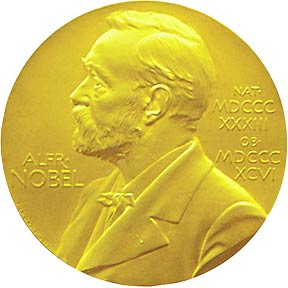
But did a group of eminent medical researchers, including a Nobel Prize-winner, just get caught doing the same thing?
Continue reading →
TrackbackPermalink March 6th, 2008 — Humor, Media
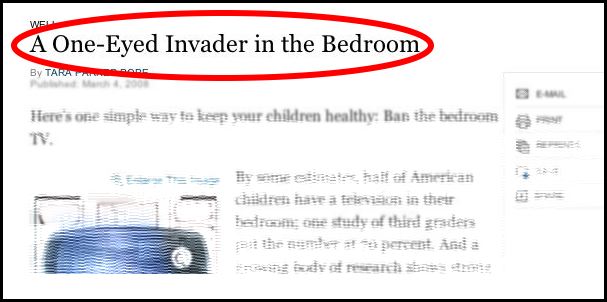
Above: A finalist in the “Unintentionally Hilarious New York Times Headlines” category, awarded by MEDIA ASSASSIN, for a Wednesday piece about, of all things, small children…and television.
But, O.K. Let’s say they missed the last 300-plus years of slang. Didn’t anyone at the Times copy desk ever see the “Johnson! Pecker!” sequence, below, from Austin Powers: The Spy Who Shagged Me?

TrackbackPermalink March 6th, 2008 — Architecture, Books, Design, NONFICTION

Peter Eisenman does not cheer at football games.
Peter Eisenman is a hardcore football fan. (The Wall Street Journal called him “an unrepentant sports nut.”) He has been buying season tickets to NY Giants games for a half-century.
He doesn’t cheer at them.
A month ago, he had what most sports fans could have only described as an out-of-body experience: He went and saw his favorite pro football team—50 years running—win one of the most amazing championship victories in sports history—Super Bowl XLII, his first.
He didn’t cheer.
But even more, of the 60,000 people who saw the event live, Peter Eisenman was the only person sitting in University of Phoenix Stadium, pictured above, who, while watching those men do battle, could look out at the retractable roof; its roll-in natural grass field; the completely unobstructed seating; and the massive supercolumns supporting the whole structure, say two little words, and be telling the truth.
“My baby.”
 Peter Eisenman, of Eisenman Architects, designed University of Phoenix Stadium. Peter Eisenman watched his first live Super Bowl as it was won with feats of superhuman cunning and strength by a team he’s loved all of his adult life in a massive stadium people are raving about but that he remembers when it weighed less than a paper clip, when it was nothing but a pattern of neurons firing in his formidable brain.
And he still didn’t cheer.
He’s either the coolest or the most tightly-wound person ever made. Me? If I’d held all that passion, history, talent, and juice inside me, after Plaxico Burress’s game-ending catch, I’d have let out a Cuba-Gooding-Jr.-winning-best-supporting-actor-at-the-Academy-Awards style war cry squared, run out onto the field naked, and set myself on fire. But I guess that’s why I’m not Peter Eisenman.
That I’m not Peter Eisenman is also why I didn’t spend Super Bowl Sunday seated next to the smart, slender, friendly, and blonde Cynthia Davidson. The person who knows that Eisenman doesn’t scream over great plays (“We high-five! He yells when he’s angry, not when he’s happy”) knows an awful lot more about him, enough to fill a book. So she did one.
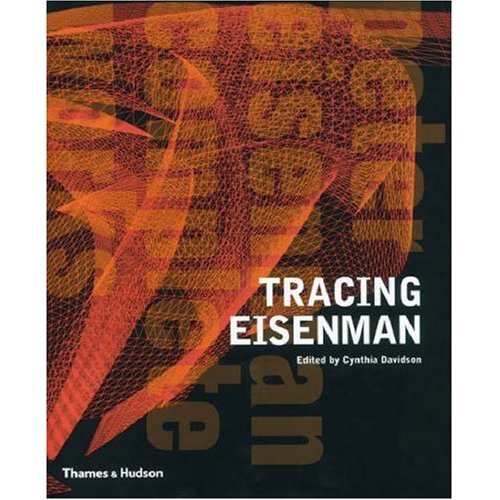 I’m talking with Cynthia about that book tomorrow, Friday, March 7, at 2 pm ET, on NONFICTION, my weekly WBAI-NY / 99.5 FM radio show, broadcasting terrestrially in the NYC tri-state, and streaming live here. The book’s called Tracing Eisenman: Peter Eisenman Complete Works (Thames & Hudson). It details Eisenman’s history and ouevre as only someone who knows him well, understands his intent, but who was an architectural critic and theorist before she met him, might do. Cynthia is cofounder of the nonprofit Anyone Corporation, and editor on a dozen books for MIT Press’s Writing Architecture series. As well, she publishes Log, an architectural journal.
Continue reading →
TrackbackPermalink March 6th, 2008 — Black Music, Pop Culture
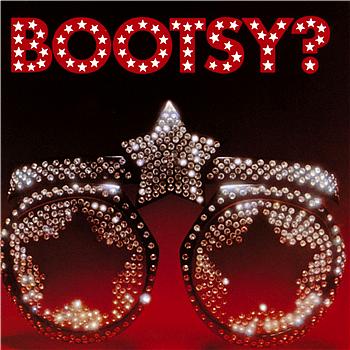
Thanks to Public Enemy bassist Brian Hardgroove for this hour-long interview with William “Bootsy” Collins.
Truly one of my cultural heroes, Collins played bass on such great James Brown records as “Sex Machine,” beginning at the age of 17, then moved on to working with Parliament-Funkadelic, before ultimately forming his own Bootsy’s Rubber Band.
I first heard him, and of him, in 9th grade, with the release of his 1978 Warner Bros. album, Bootsy? Player of the Year, above, and the single “Bootzilla.” That record, which, somehow, ended up on the end of this interview, kinda scared me when I listened to it the first time…but in a good kind of way.
I later met Bootsy, and got to interview him, around 2000, when I was working on an unfinished radio doc—that I kinda wanna get back into—about the history of the bass guitar in popular music. He was a warm and gentle guy, natural, absent of ego, which is amazing when you consider his tremendous talent.
Perhaps because they’re both bassists, Hardgroove and Bootsy talk not a whit about technique, or fundamentals, or advanced theory when playing their instrument. They know how, so why talk about it? I’d have liked to hear some of that, but there’s probably a lot I’d like to ask Collins.
What’s here is very rich, like when Bootsy talks about playing on his first Brown record: “The Grunt.: That’s the same record P.E. pulled samples off for tracks like “Night of the Living Baseheads” and, most uniquely, “Rebel Without a Pause.”
So, listen, and, when you’re done, or whenever, shoot over here and check out this 4:26 clip, possibly from 1978, of Bootsy in concert, performing a Space Bass solo. (Is that “(You’re a Fish & I’m a) Water Sign”?) Remember to pick up any leftover pieces of your mind after it’s blown.
TrackbackPermalink March 6th, 2008 — Design, Energy, Environment, Science

Did a young and promising clean-energy consortium just give a big prize to the wrong guy?
This cool “gravity-based kinetic energy lamp,” Gravia, above, by designer Clay Moulton, placed second at the Greener Gadgets Conference (GGC)’s design competition, held here in New York City, on February 1.
Said the contest summary,
The driving idea of Gravia is that light is generated when the user raises weights from the bottom to the top of the lamp. As the mass slowly falls it spins a rotor. The energy created by the movement is harnessed by an internal mechanism to make electricity. Ten high-output LEDs light the four foot high acrylic column with a diffuse glow (600-800 lumens) for about 4 hours of ambient light.
You can see a schematic here.
Obviously, using gravity for power means environmental cleanliness exceeding the surgical. Gravity is a fundamental, universal force, everywhere, free, abundant.
But there’s a problem with the prize-winning Gravia, a big one:
Gravia isn’t actually manufacturable: “The criticism is that a great deal of weight –- tons — would be required [for it to work] and [, as well,] current LEDs are not sufficiently efficient.” Designer Clay Moulton has acknowledged this fact and says that [“]the current design is probably not possible given current LED technology, but could be soon.”
Continue reading →
TrackbackPermalink March 5th, 2008 — Advertising, Automotive, Hip-Hop, Music, TV

I don’t really care about the new $44,825, 2008 Mercedes-Benz M-Class, or Benzes generally, but I would give my eyeteeth to get a high-quality loop of the music that beds this commercial, titled “Most.”
In the spot, while car action footage mixes with testimonials to M-B superiority from Mercedes engineers, factory workers, and other employees, a full chorale sings a hushed epinicion, or song of triumph, underneath. One can detect a bowed string bass, and very occasional, light percussion. Together, the sound is warm…and expectant.
Continue reading →
TrackbackPermalink March 5th, 2008 — Uncategorized
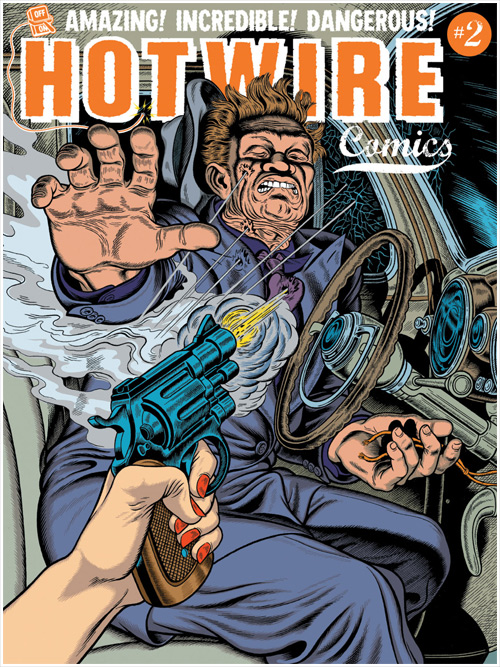
If you ask me, it takes a lot to make a woman wanna put a tightly packed grouping like that through a man. So, when it happens, you better believe he did something to ground her last nerve beneath his scuffed Johnston & Murphys. Like Max growled in the Hart to Hart intro, when these two met, it was murder.
Not to condone homicide, of course. Merely to praise Tim Lane’s gritty cover art for Fantagraphics Books’ Hotwire Comics Vol. 2, which continues the title’s standard for packing as many harshly drawn tales of scuminess, dread, and revenge into one volume as possible. Pieces by Danny Hellman, Ivan Brunetti, Chadwick Whitehead, Johnny Ryan, and a masterwork by Glenn Head make the pages pulse. I’m pretty crazy about the stuff this publisher does…and hiding my gun from Zakiya.
TrackbackPermalink March 5th, 2008 — Black Music, Entertainment, Hip-Hop, Music, Pop Culture
Look at the following list:
Public Enemy, It Takes a Nation of Millions to Hold Us Back
N.W.A, Straight Outta Compton
Slick Rick, The Great Adventures of Slick Rick
EPMD, Strictly Business
Boogie Down Productions, By All Means Necessary
Big Daddy Kane, Long Live the Kane
Ultramagnetic MC’s, Critical Beatdown
Eazy E, Eazy-Duz-It
Eric B. & Rakim, Follow the Leader
Biz Markie, Goin’ Off
Salt-N-Pepa, A Salt with a Deadly Pepa
DJ Jazzy Jeff & the Fresh Prince, He’s the DJ, I’m the Rapper
Jungle Brothers, Straight Out the Jungle
Now, consider this: All of these albums were released in one twelve-month period, in 1988.
I could keep going. Marley Marl, In Control, Vol. 1. Kool G Rap & DJ Polo, Road to the Riches. King Tee, Act a Fool. Ice-T, Power. 2 Live Crew, Move Somethin’. Too Short, Life is…Too Short.
What, exactly, happened twenty years ago that enabled so many artists to release so many albums of such high quality is such a short period of time? What created hip-hop’s annus mirabilis; “year of miracles”?
Today, Wednesday, March 5, 2008, 2 pm ET, I’ll be on WNYC/93.9 FM’s Soundcheck, with John Shaefer, talking to John and RS.com (Rolling Stone) editor Kyle Anderson, attempting to address this very question. (Later on, I’ll also be talking about with John about my VIBE piece on Palestinian hip-hop.) RS.com has their own analysis, here, and Soundcheck has a link, in case you missed the live broadcast. Let’s see if we can move somethin’.
TrackbackPermalink March 5th, 2008 — Crime, Magazines, Race
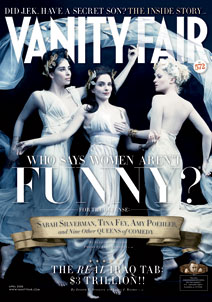 Yesterday, I wrote about my respect-recoil relationship with Vanity Fair magazine, as I felt “love-hate” was too flat to shade the nuances of my feelings about the publication. As I said then, what I detest is its racial myopia; a close focus on stories by, and about, white people. This is something basic to American media, “normal,” in certain ways, but increasingly glaring, for many reasons, at this magazine.
So what do I respect about Vanity Fair?
As a writer whose career has mostly been built around writing for magazines, I’m always struck by the editorial heft of Conde Nast pubs; the way good editing and design works to create an almost tactile reading experience.
I’ve said “of Conde Nast publications,” so this is their corporate quality, but Vanity Fair is the flagship. At the magazine, their features are practically oaken with the quality that substantial resources and vision can buy a publication. The writing is not only top-notch but standard-bearing; the photography is legendary. Typically, when I buy a Vanity Fair, I don’t even rush to read it. I know that the articles typically take a long view that will make good study a month, or three, or six, or a year later.
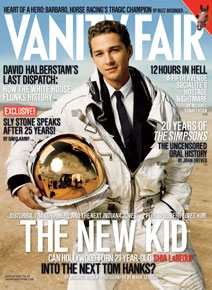
Last year, before blog—this past August, precisely—Vanity Fair ran big pieces on musical revolutionary Sly Stone and The Simpsons, both of which got covered elsewhere. (In fact, in the October issue, with the Nicole Kidman cover, VF posted a Simpsons letter-to-the-editor by this writer.)
 Continue reading →
TrackbackPermalink March 4th, 2008 — Magazines, Media, Pop Culture, Race

To say I have a love-hate relationship with Vanity Fair would be sort of putting it baldly, and imprecisely. It’s more of a respect-recoil connection that we share.
What do I respect, and from what do I recoil?
Well, I don’t want to rush this, so what I’ll do is take each aspect one at a time, over the course of today and tomorrow, saving the best for last.
What makes me recoil from Vanity Fair is that the magazine, based on both its content and writing staff, seems to tightly embrace a dated form of racial near-sightedness. I call it anachronistic achromatism. It’s a magazine, Sly Stone be damned, about white people, for white people, and, especially, by white people. This is the norm in American media, but VF makes a deference to whiteness that seems, on this small, brown, post-9/11 planet, not just brazenly out-of-touch, but, even more, recklessly hopeful.
Continue reading →
TrackbackPermalink