It takes one to know one: Hillary counts on her peeps
I never get tired of news footage that documents blatant racism. Also, when it’s coming from Al-Jazeera English, you know it’s got to be good. It’s going in some direction that the self-congratulatory, corporate U.S. media, still suckling the dry, cracked teat of American exceptionalism, is completely unwilling to go.
Then, it occurred to me that everything in the show is probably already owned by white Brits.
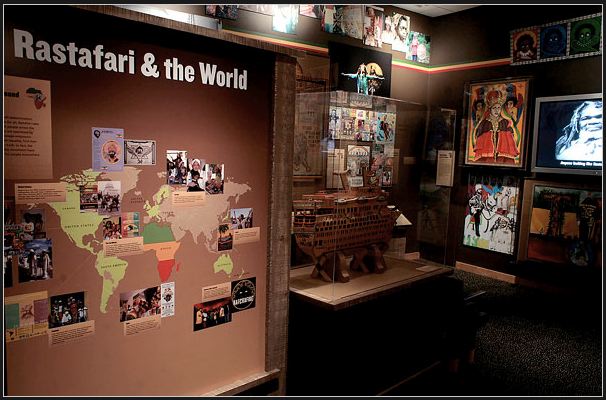
Then there’s this question, which The New York Times, itself, raises: Why is this exhibit in the Smithsonian’s Museum of Natural History?
the Rastafari exhibition does not really belong in the same museum as paleontological finds and collections of insects and gems. That placement is a relic of the 19th-century conception of the natural history museum as a temple devoted to exotic “natural” cultures and objects — evolutionary predecessors of the scientific West.
“Be vewwy quiet. I’m hunting duckets”: Poor old rich guy
I find the nuances of wealth endlessly fascinating. But the aspect of it that I find most intriguing is the carefully maintained illusion of limitless capacity the rich apparently work to maintain.
Conservative bloggers had raised the the charge that Ray’s scarf, in the print ad, above, was a keffiyeh. This, “for the clueless,” as screechy Fox News commentator Michelle Malkin warmly explained on her web site,
is the traditional scarf of Arab men that has come to symbolize murderous Palestinian jihad. Popularized by Yasser Arafat and a regular adornment of Muslim terrorists appearing in beheading and hostage-taking videos, the apparel has been mainstreamed by both ignorant (and not so ignorant) fashion designers, celebrities and left-wing icons.”
You might think that a student with a double major in Geography and Russian & Slavic Studies—one matriculating in about a year, before heading to grad school—might have more to do at 4 a.m. than create a geographic outline of the places rapper Ludacris likes to pick up chicks, based on his 2001 Word of Mouf single w/ Nate Dogg, “Area Codes,” above. (Click on the map to enlarge it, then again to see it at maximum size.)
But, if you do think that, you neither know the contradictions of higher ed nor the peccadilloes of Stefanie Gray. (You also haven’t been to the incredible Strange Maps blog, where I first saw this.)
There, the CUNY Hunter College undergrad, right, notes, “I’m a female and a feminist. I dislike the usage of the word ‘ho’. However, as a geography major, I find this song hilarious, and had to map it.”
QUESTION: Have you ever noticed that the “Nicest Kids in Town” dance sequence, from the hit 2007 musical, Hairspray, syncs perfectly with “Ante Up (Remix),” the 2000 Funkmaster Flex track by M.O.P., Busta Rhymes, and Remy Ma?
STORY: It’s 1962 in Baltimore, Maryland. Tracy Turnblad (Nicole Blonsky) is in school, merely tolerating chemistry class, anxiously waiting for it to end. When the bell finally rings, she dashes out and grabs her best friend, Penny Pingleton (Amanda Bynes). “Penny! Come on, hurry!” she urges. “Push, we’re late!”
While the two run fast as they can over to Tracy’s house, in a darkened studio across town, camera crews set up shots and slickly-dressed teens spin on their heels, taking special care to “douse their ‘do’s'” in Ultra Clutch. It’s The Corny Collins Show! One minute to air!
Tracy and Penny burst through the door and turn on the television, just in time for the start of their favorite weekday afternoon TV program. Soon, they’re moving to the beat as Corny (James Marsden), Link Larkin (Zac Efron), and “the nicest kids in town” do the hottest dances to the latest song!
INSTRUCTIONS: Forward this to your friends! Though audio is NSFW, play loudly, share widely, and enjoy!
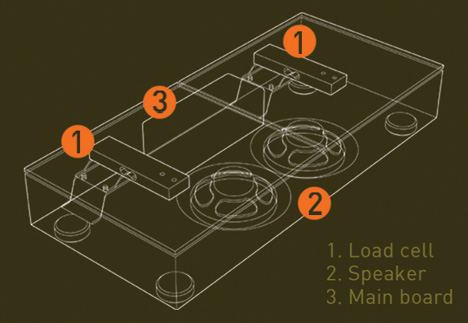
Korean designer Cheol-Ki Jo’s radical redesign of a common houshold radio results in one with no knobs, slide pots, or other usual controls for volume and tuning.
Instead, users place stones of varied sizes on top of the wood case. Certain circular areas there are designed to electronically register pressure via “load cells,” as seen in the diagram at right.
Depending on the weight being balanced upon the two radial surfaces, the concept unit’s volume and frequency are adjusted, making this less of an actual device and more of an art installation piece. It’s still an interesting idea (“Honey, can you give me back the speckled white stone and the three black pebbles so I can listen to NPR?”).
Art installation piece, or maybe children’s device, generating a true experience of discovery and play? Whatever, it represents some serious top-of-the-box thinking.