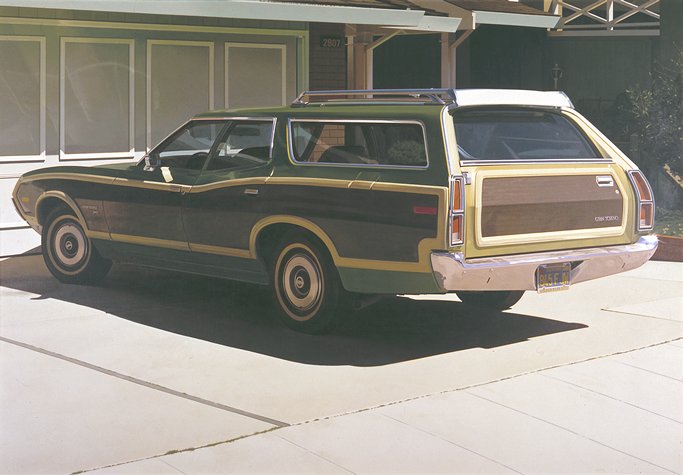
Robert Bechtle’s 1974, 48 in. by 69 in. oil, Alameda Gran Torino, is a masterpiece of the photorealistic style he mastered in the 1960s and ’70s.
In his 2005 review of the artist’s work, The New Yorker‘s Peter Schjeldahl called Bechtle’s images visions “from a prior life,” and Alameda Gran Torino, paradoxically, “a nova of banality.”
The station wagon can’t help but be only and exactly what Detroit fashioned. Hot sunlight can’t help but glint from a bumper and produce a faint reflection of the windshield on a garage door. A closeness between the green of the car and that of a background shadow is unusual, but so perfectly meaningless that your mind may panic at the waste of its energy in beholding the fact. Then something peculiar can happen: your reflexive sense of the picture as a photograph breaks down, and the object’s identity as a painting, done entirely on purpose, gains ground. Look closely. A congeries of tiny freehand strokes delivers an inconspicuous patch of foliage. The whole work is a feat of resourceful painterly artifice. At last, it’s as if the original photograph were a ghost that died and came back as a body.
The familiar, sky-blue font is there, but the usual, loud, hyperventilating, all-caps text is not.
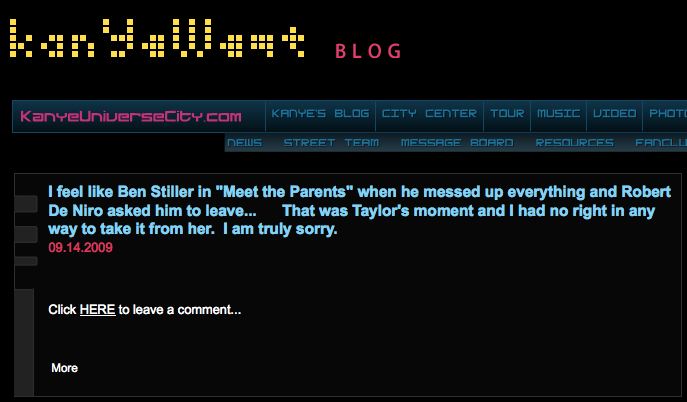
Instead, last night on his blog, Kanye West gave the apology that, perhaps, fans and foes had wanted to hear all along.
Comparing himself to Gaylord “Greg” Focker, the luckless character played by Ben Stiller in the 2000 film, Meet the Parents, West admitted that, with his bum rush of the MTV Video Awards on Sunday, he’d “messed up everything.”
That was Taylor’s moment and I had no right in any way to take it from her. I am truly sorry.
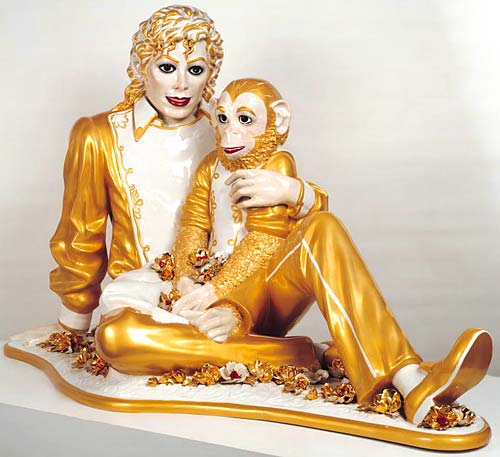
Random thought I had today: With the King of Pop’s death in June, the price of superstar conceptual artist Jeff Koons‘ famed 1988 sculpture, Michael Jackson and Bubbles, above, must be rocketing in value. (Made in an edition of three, plus an artist’s proof, one of the life-sized, 42 in. x 70 1/2 in. x 32 1/2 in. porcelain tchotchkes sold at auction for $5.6 million in 2001.)
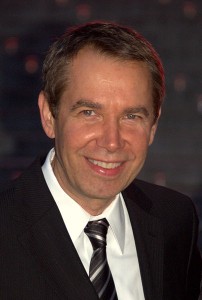
Indeed, legendary art dealer Larry Gagosian, who reps Koons, right, told The New York Times back in July that if one of the creations
was to come up for sale now, it could make more than $20 million. “And that’s conservative,” he added.
The first of Gay Tony‘s, certainly, several trailers, each deepening the sordid narrative of the game’s fictional Liberty City, dropped yesterday. Titled, “You’ll Always Be the King of This Town,” it’s a whirlwind of beautifully chaotic scandal.
You all get Fs: Mixed Company sets Asians back thousands of years
Adam Clayton Powell was fond of noting that Harvard University had “ruined more Negroes than bad whiskey.” Well, perhaps his Korean counterpart is somewhere saying the same thing about Asians at Yale.
That was my first random thought when I saw this bit, today, on YouTube: Purported members of the Mixed Company of Yale University chorale, above, shuffling to their reworked version of Beyonce’s “Single Ladies”: “Single Asians.”
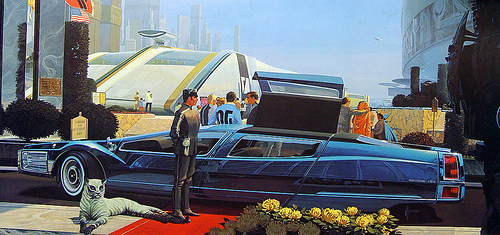
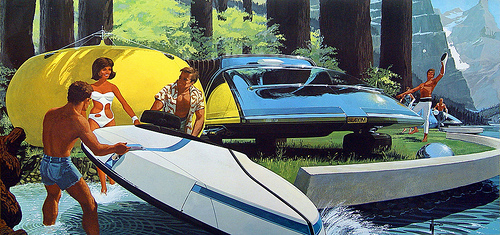
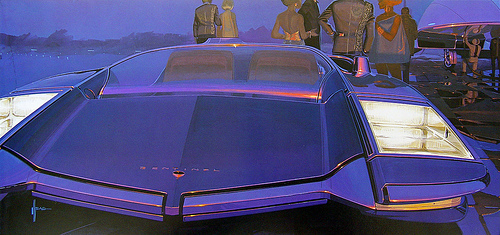
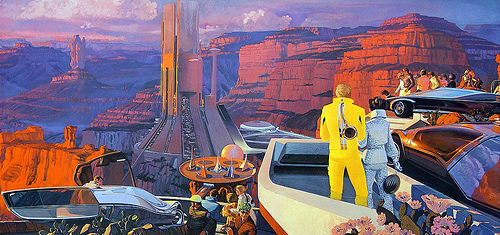
For years, conceptual designer Syd Mead has been the man to whom companies go when they need to advance an audacious vision of the impending future.
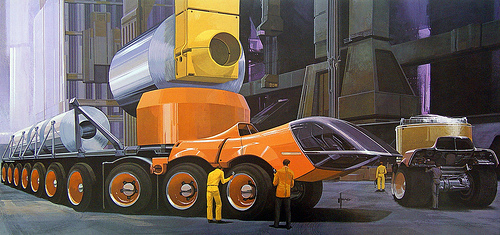
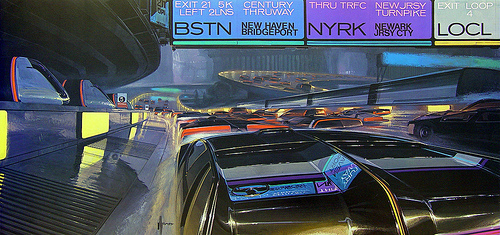
Sydney Jay Mead was born in 1933, in Saint Paul, MN, to a Baptist minister and his wife. After graduating from the Art Center in Los Angeles in 1959, he worked at Ford Motor Company’s Advanced Styling Center in Dearborn, MI for two years. He then spent part of the next decade rendering now legendary concept illustration for U.S. Steel, above. “He painted,” one Mead fan site notes, “using a slick, detailed method that made the future seem fresh, clean, and thrilling.” He started Syd Mead, Inc. in 1970.
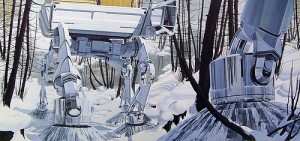
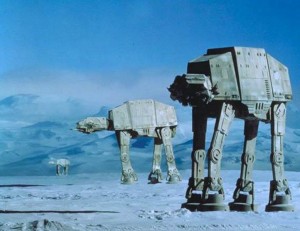
Soon, Hollywood came calling with movies that required his ultra-hard, visually authentic and tactile designs. (Mead lists his favorite metal as “chrome,” and his favorite color is, gulp, “Cherenkov radiation blue.”) His indelible technological notions were then emblazoned on sci-fi like Star Trek: The Motion Picture, Aliens, and Tron. (Indeed, some would argue that his US Steel snow walker, above right, obviously influenced another one in a galaxy far, far away, below right.)
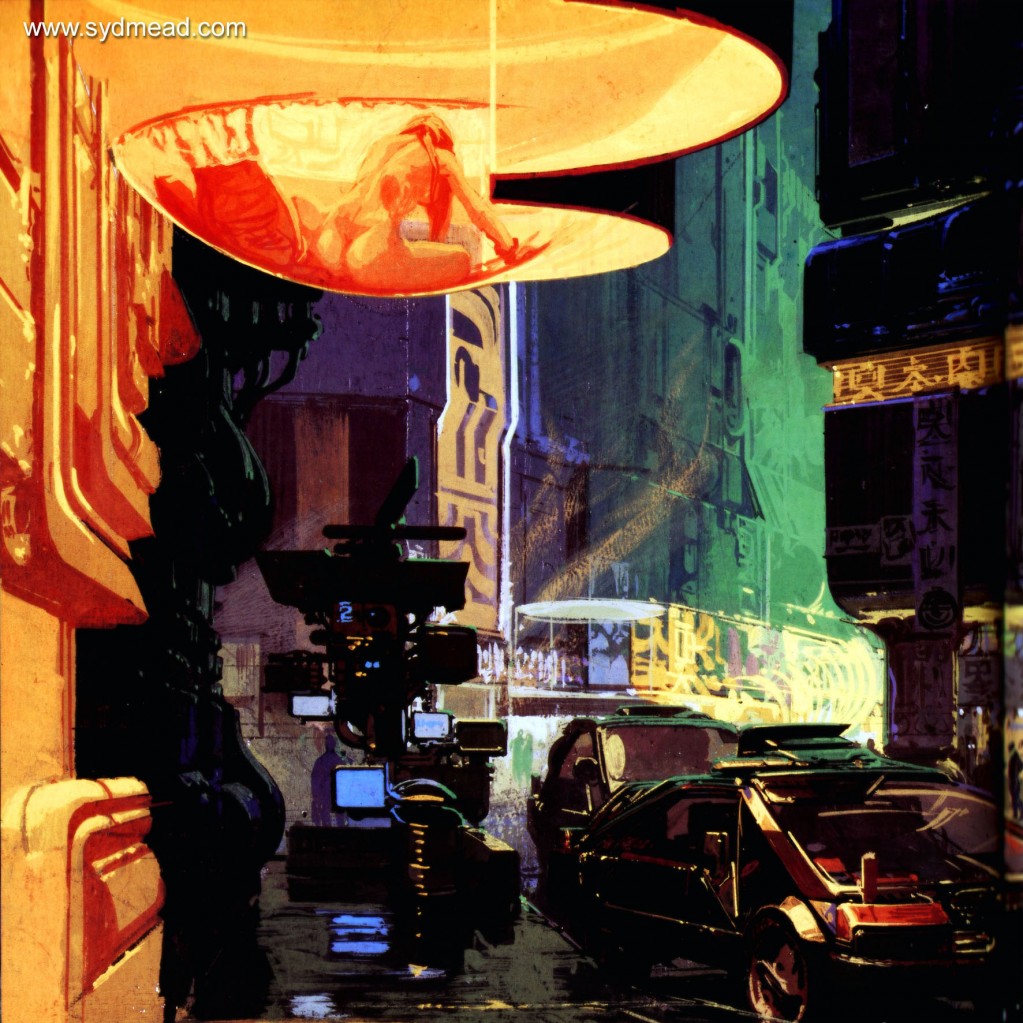
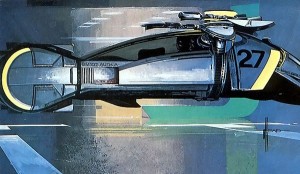
But it was Blade Runner, right, Ridley Scott’s 1982 classic, on which Mead’s dystopic gigalopolis, both below right, most sears every frame. “In essence,” says author Paul Sammon (Future Noir: The Making of Blade Runner), “what you’re seeing in many shots are almost three-dimensional representations of Syd Mead’s art.”
Sammon, Mead, director Steven Lisberger (Tron) and other industry vets testify in director Joaquin Montalvan’s 2005 documentary, Visual Futurist: The Art & Life of Syd Mead. The film tells Mead’s story from his own perspective, as well as from that of the people with whom he’s worked. It’s a rich document about a little-known man, but one whose whose ideas are deeply and widely embedded in American popular culture.
Joaquin Montalvan is a guest today on my WBAI-NY / 99.5 FM radio show, NONFICTION, this afternoon, Friday, August 21, at 2 pm ET.
But first we’ll speak to Jason Del Gandio, author of Rhetoric for Radicals: A Handbook for 21st Century Activist, a guide for the ultra-political on how to effectively communicate. “Here’s the underlying logic” of his book, Del Gandio says:
• Change the rhetoric and you change the communication.
• Change the communication and you change the experience.
• Change the experience and you change a person’s orientation to the world.
• Change that orientation and you create conditions for profound social change.
You can hear Jason Del Gandio’s and Joaquin Montalvan’s ideas by tuning in at 2 pm. If you’re outside of the New York tri-state, check out our stream on the web. If you miss the live show, dig into our archives for up to 90 days after broadcast.
To make them appear more like a typical Angolan family, Marge has also been given a black Afro hairstyle instead of normal blue bouffant, while Lisa’s hair is stood up on end in short braids.
The image also shows the family dressed in clothes bearing traditional African designs and they are all wearing flip flops.
To be clear, this change was not made to the actual animation, but to print advertising being shown in the broadcast area.
Let’s hope so, and let’s trust they won’t be put off, here, by dumb, cloying marketing at its worst, and, in so doing, avoid what’s still a very funny show.
VIBE’s 1997-1998 syndicated TV show was an utter mess, as the dates of its miniscule timeline suggest. For some reason, its creators didn’t see, and were completely unable to translate from print, the dynamic and sparkly juxtapositions that made the magazine, at its peak, an unusually incandescent hit. (The periodical was completely uninvolved with the TV broadcast.)
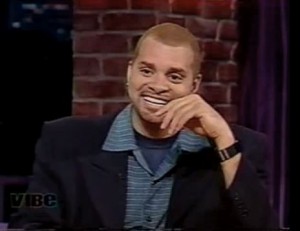
The program always felt sluggish and old. (Hiring Sinbad, right, as the second host, after comic Chris Spencer’s anemic few months, did little to correct this.) It was as if someone had found a tattered, bled-through copy of the magazine in a trash heap, saw the name, liked it, and decided to make a program with it out of whatever stage props they had on hand. When it debuted, I watched it at a nearby bar with others from our office, but almost never after that. It’s not a high point in the magazine’s hallowed history.
There’s one moment from VIBE I remember, however, and it’s the only bit I ever saw there that not only still cracks me up, but that, to me, hinted at the show’s possibilities.
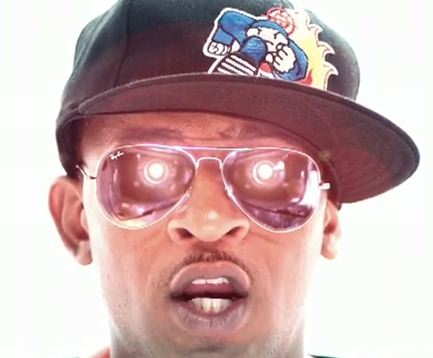
You know hip-hop is in a quandary when rappers with fortunes as disparate as Jay-Z’s (“D.O.A.: Death of Auto-Tune”) and Black Moon’s Buckshot’s, above, are crying for profound artistic change. With the addition of the culture’s grand oak, KRS-One, to the fray, however, we now have a call for reform with true moral weight and undiffused authority.
That siren sounds loudly on KRS and Buckshot’s lead single, “Robot,” from their upcoming album, Survival Skills. Against director Todd Angkasuwan’s sparse digital vistas, the video portrays the duo as last men standing in a music world gone wholly fake, one filled with genetically spliced rappers and synthetic video dancers. Keeping with their theme of order-obeying, mechanical men, there’s even a brief cameo from Optimus Prime, though, thankfully, none from Skids and Mudflap. Check it out, below, and then peep their brief “making of” feature.
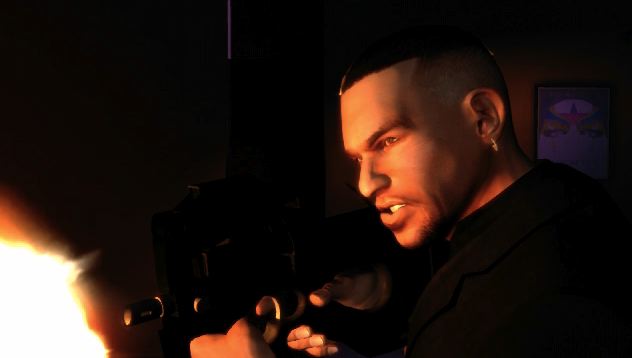 Gay Tony‘s hitman, Luis Lopez, lights up the night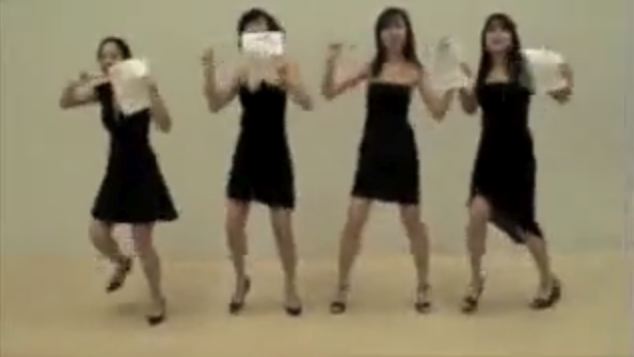
 Soon, Hollywood came calling with movies that required his ultra-hard, visually authentic and tactile designs. (Mead lists his favorite metal as “chrome,” and his favorite color is, gulp,
 But it was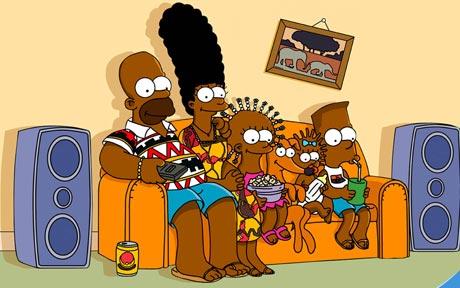
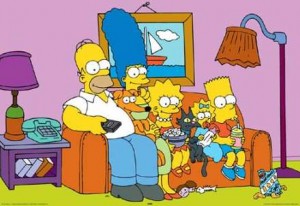 Those are the results, above, says the UK’s Telegraph: “Brown skin instead of their usual yellow,” right.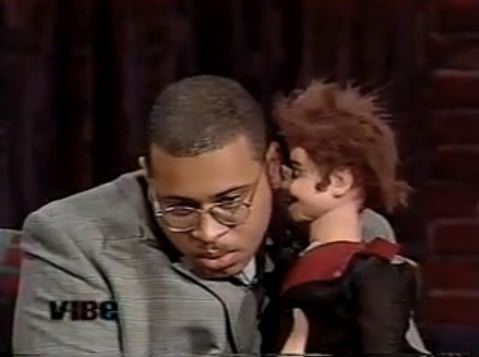
 The program always felt sluggish and old. (Hiring Sinbad, right, as the second host, after comic Chris Spencer’s anemic few months, did little to correct this.) It was as if someone had found a tattered, bled-through copy of the magazine in a trash heap, saw the name, liked it, and decided to make a program with it out of whatever stage props they had on hand. When it debuted, I watched it at a nearby bar with others from our office, but almost never after that. It’s not a high point in the magazine’s hallowed history.